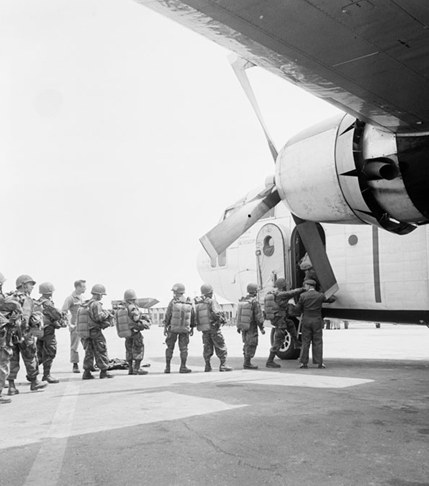
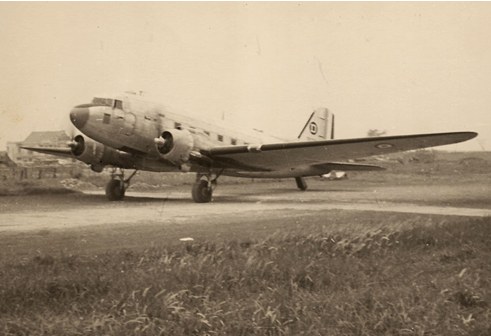
To prepare for this critical campaign, both sides made fairly meticulous logistical plans. On 20 November, the French used 63 Dakota C-47 aircraft flights to drop 2 battalions and 1 light airborne regiment with 3,000 paratroopers and ordnance into Điện Biên Phủ. Two days later, on 21 and 22 November, 3 airborne battalions and an artillery company were successively dropped. After only 4 days, the old Mường Thanh airfield had been repaired for use. Six fighter aircraft and reconnaissance planes began to be stationed at the airfield. The airlift supplying the fortified complex was officially operational.
Để chuẩn bị cho chiến dịch quan trọng này cả hai bên đều lên kế hoạch hậu cần khá chu đáo. Ngày 20 tháng 11, quân Pháp cho 63 chuyến máy bay Dakota C-47 thả 2 tiểu đoàn và 1 trung đoàn dù nhẹ với 3.000 lính dù và quân cụ xuống Điện Biên Phủ. Hai ngày sau, ngày 21 và 22 tháng 11, liên tiếp 3 tiểu đoàn dù cùng một đại đội pháo binh được thả xuống. Chỉ sau 4 ngày, sân bay cũ Mường Thanh đã được sửa chữa để đưa vào sử dụng. Sáu máy bay chiến đấu và các máy bay trinh sát bắt đầu đóng tại phi trường. Cầu hàng không cung cấp cho Tập đoàn cứ điểm đã chính thức hoạt động.
Pour préparer cette campagne cruciale, les deux camps élaborèrent des plans logistiques assez minutieux. Le 20 novembre, les Français utilisèrent 63 vols d'avions Dakota C-47 pour larguer 2 bataillons et 1 régiment aéroporté léger avec 3 000 parachutistes et du matériel militaire sur Điện Biên Phủ. Deux jours plus tard, les 21 et 22 novembre, 3 bataillons aéroportés et une compagnie d'artillerie furent successivement largués. Après 4 jours seulement, l'ancien aérodrome de Mường Thanh fut remis en état pour être utilisé. Six avions de chasse et de reconnaissance commencèrent à être stationnés sur l'aérodrome. Le pont aérien approvisionnant le camp retranché fut officiellement opérationnel.
With direct reinforcement, goods and ordnance poured in en masse by the French to rapidly construct the base. A vast volume of construction materials such as cement, iron and steel was transported in; barbed wire alone amounted to 3,000 tons. Equipment serving the daily life and combat needs of tens of thousands of troops was swiftly provided. A series of special weapons for defense in depth were brought in, such as explosives, mines, incendiary bombs, gas masks against smoke shells, infrared devices… even quad-barrel anti-aircraft guns and flamethrowers were equipped to create suppressive firepower. Knowing that the Vietnamese forces already had artillery, a 155 mm artillery unit specifically used for counter-battery fire was equipped…1
Có tiếp viện trực tiếp, hàng hoá quân cụ được quân Pháp kìn kìn chở tới để nhanh chóng xây dựng căn cứ. Một khối lượng lớn vật liệu xây dựng như xi măng, sắt thép được vận tải đến, chỉ tính riêng dây thép gai đã lên đến 3,000 tấn. Các trang bị phục vụ sinh hoạt và tác chiến cho hàng vạn quân được nhanh chóng trang bị. Hàng loạt vũ khí đặc biệt dành cho phòng ngự chiều sâu đã được trở tới như thuốc nổ, mìn, bom lửa, mặt nạ che đạn khói, máy hồng ngoại tuyến…ngay cả súng phòng không 4 nòng, súng phun lửa cũng được trang bị để tạo hoả lực uy hiếp. Biết bộ đội Việt Nam đã có pháo binh, một đội pháo 155 mm chuyên dùng để phản pháo đã được trang bị,…1
Bénéficiant d'un renforcement direct, les marchandises et le matériel militaire affluèrent en masse du côté français pour construire rapidement la base. Un vaste volume de matériaux de construction tels que du ciment, du fer et de l'acier y fut acheminé ; le fil barbelé atteignit à lui seul 3 000 tonnes. L'équipement nécessaire à la vie quotidienne et au combat de dizaines de milliers de soldats fut rapidement fourni. Une série d'armes spéciales destinées à la défense en profondeur fut apportée, telles que des explosifs, des mines, des bombes incendiaires, des masques à gaz contre les obus fumigènes, des dispositifs infrarouges… Même des canons antiaériens quadruples et des lance-flammes furent déployés pour créer une puissance de feu de suppression. Sachant que les forces vietnamiennes possédaient déjà de l'artillerie, une unité d'artillerie de 155 mm spécifiquement utilisée pour les tirs de contre-batterie fut mise en place…1
French troop strength in Điện Biên Phủ increased rapidly. By 3 December, there were 9 battalions and two artillery units, then increasing to 10, 11, and finally 12 battalions, 10 M-24 tanks, three 105 mm and 155 mm artillery batteries, along with 4 120 mm mortar battalions, totaling 16,200 personnel pouring into the Điện Biên basin. Accompanying the combat forces were combat-supporting equipment, ammunition, materiel, fuel, food, and medicine. By 13 March 1954, the fortified complex had accumulated reserves of 9 days of food, 8 days of gasoline fuel, 6 units of ordnance for firepower for each infantry battalion, 6 and a half units for firepower for the 105 mm artillery, 7 units for the 155 mm artillery, 8 units for the 120 mm mortars, and 9 units for the 75 mm guns of the M-24 tanks1. The logistical preparations of the French forces were complete.
Binh lực Pháp ở Điện Biên Phủ tăng lên nhanh chóng. Đến ngày 3 tháng 12, có 9 tiểu đoàn và hai đội pháo binh, rồi tăng lên 10, 11 và cuối cùng 12 tiểu đoàn, 10 xe tăng M-24, ba pháo đội 105 mm và 155 mm cùng với 4 tiểu đoàn súng cối 120 mm với tổng quân số 16.200 người đã đổ dồn vào lòng chảo Điện Biên. Kèm theo lực lượng tác chiến là trang bị đạn dược, khí tài, nhiên liệu, lương thực, thuốc men phục vụ chiến đấu. Cho đến ngày 13 tháng 3 năm 1954, tập đoàn cứ điểm đã có đủ dự trữ 9 ngày lương thực, 8 ngày nhiên liệu xăng, 6 đơn vị quân cụ phục vụ hỏa lực cho từng tiểu đoàn bộ binh, 6 đơn vị rưỡi phục vụ hỏa lực cho pháo 105mm, 7 đơn vị cho pháo 155mm, 8 đơn vị cho súng cối 120 mm và 9 đơn vị cho pháo 75 mm của xe tăng M-241. Công tác chuẩn bị hậu cần của quân Pháp đã hoàn tất.
Les effectifs français à Điện Biên Phủ augmentèrent rapidement. Au 3 décembre, il y avait 9 bataillons et deux unités d'artillerie, passant ensuite à 10, 11, puis finalement 12 bataillons, 10 chars M-24, trois batteries d'artillerie de 105 mm et 155 mm, ainsi que 4 bataillons de mortiers de 120 mm, pour un total de 16 200 hommes se déversant dans la cuvette de Điện Biên. Accompagnant les forces de combat, on trouvait des équipements de soutien, des munitions, du matériel, du carburant, des vivres et des médicaments. Au 13 mars 1954, le camp retranché avait accumulé des réserves comprenant 9 jours de vivres, 8 jours de carburant, 6 unités de feu pour chaque bataillon d'infanterie, 6 unités et demie de feu pour l'artillerie de 105 mm, 7 unités pour l'artillerie de 155 mm, 8 unités pour les mortiers de 120 mm, et 9 unités pour les canons de 75 mm des chars M-241. Les préparatifs logistiques des forces françaises étaient terminés.
General Cogny estimated that once combat began, the massive army in Điện Biên Phủ would require approximately 70 tons of supplies of all kinds per day to ensure provisions for an average level of combat, and 96 tons a day for high-intensity combat1. Such a level of support was well within the control of the French-American coalition. By 1954, 78% of French war expenditures in Indochina were paid for by the United States. In 1953, American aid, both economic and military, had reached 2.7 billion, of which military aid was 1.7 billion dollars; in 1954, the US provided an additional 1.3 billion dollars in aid.
Tướng Cogny ước lượng khi bắt đầu tác chiến, đội quân khổng lồ ở Điện Biên Phủ sẽ cần khoảng 70 tấn vật tư các loại trong một ngày để đảm bảo cung ứng cho mức chiến đấu trung bình và 96 tấn một ngày khi chiến đấu ở mức độ cao1. Mức độ hỗ trợ như vậy nằm trong tầm kiểm soát của liên quân Pháp-Mỹ. Cho đến năm 1954, 78% chiến phí của Pháp ở Đông Dương đã do Hoa Kỳ chi trả. Năm 1953, viện trợ Mỹ cả kinh tế và quân sự đã lên tới 2,7 tỷ trong đó viện trợ quân sự là 1,7 tỷ đôla, năm 1954 Mỹ viện trợ thêm 1,3 tỷ đô la nữa.
Le général Cogny estima qu'une fois les combats engagés, l'armée massive présente à Điện Biên Phủ nécessiterait environ 70 tonnes d'approvisionnements de toutes sortes par jour pour garantir le ravitaillement d'un niveau de combat moyen, et 96 tonnes par jour pour un combat de haute intensité1. Un tel niveau de soutien était largement à la portée de la coalition franco-américaine. En 1954, 78 % des dépenses de guerre françaises en Indochine étaient payées par les États-Unis. En 1953, l'aide américaine, tant économique que militaire, avait atteint 2,7 milliards, dont 1,7 milliard de dollars pour l'aide militaire ; en 1954, les États-Unis fournirent une aide supplémentaire de 1,3 milliard de dollars.
Transporting this vast volume of goods was entirely within the normal logistical capabilities of the French Air Force. From the beginning of the war, the Air Force of the French Expeditionary Corps in Indochina had at its disposal 75 Dakota C-47 transport aircraft and 5 C-119s provided by the US. By 1 February 1954, the number of Dakota aircraft had increased to 100, alongside 16 American civilian Packet C-119 aircraft commanded by the American General Chennault in support, not to mention various French civilian aircraft such as the C-46, Bristol, DC-4, and SO30P… operating in Indochina1. The Mường Thanh airfield could normally receive about 60-80 supply flights per day.
Mức chuyên chở khối lượng hàng hoá to lớn này hoàn toàn nằm trong khả năng tiếp vận bình thường của không quân Pháp. Không quân Viễn chinh Pháp tại Đông Dương từ lúc khởi đầu cuộc chiến đã có trong tay 75 chiếc máy bay vận tải Dakota C47 và 5 chiếc C -119 của Mỹ giúp. Tới ngày 1 tháng 2 năm 1954, số máy bay Dakota tăng lên 100 chiếc và 16 máy bay dân sự Mỹ Packet C-119 của tướng Mỹ Chenault chỉ huy hỗ trợ chưa kể đến nhiều loại máy bay dân sự của Pháp loại C-46 , Bristol, DC-4 và SO30P,…đang hoạt động ở Đông Dương1. Sân bay Mường Thanh có thể tiếp nhận ở mức bình thường khoảng 60-80 chuyến tiếp vận/ngày.
Le transport de ce vaste volume de marchandises relevait entièrement des capacités logistiques normales de l'Armée de l'air française. Dès le début de la guerre, l'aviation du Corps expéditionnaire français en Indochine disposait de 75 avions de transport Dakota C-47 et de 5 C-119 fournis par les États-Unis. Au 1er février 1954, le nombre d'avions Dakota s'élevait à 100, appuyés par 16 avions civils américains Packet C-119 commandés par le général américain Chennault en soutien, sans compter divers avions civils français tels que les C-46, Bristol, DC-4 et SO30P… opérant en Indochine1. L'aérodrome de Mường Thanh pouvait normalement recevoir environ 60 à 80 vols d'approvisionnement par jour.
On the side of the Vietnam People's Army, the logistical burden was far greater than that of their adversary. The General Staff of the Vietnam People's Army and the General Department of Supply calculated that the frontline combat troops needed to be supplied with 4,200 tons of rice, 100 tons of vegetables, 100 tons of meat, 80 tons of salt, and 12 tons of sugar, transported over hundreds of kilometers of treacherous, steep mountain passes, and frequently subjected to French aerial bombardment.
Về phía quân đội Nhân dân Việt Nam, gánh nặng công tác hậu cần lớn hơn đối phương rất nhiều. Bộ Tổng Tham mưu Quân đội Nhân dân Việt Nam và Tổng cục Cung cấp tính toán bộ đội trực tiếp chiến đấu cần cần được cung ứng 4.200 tấn gạo, 100 tấn rau, 100 tấn thịt, 80 tấn muối, 12 tấn đường vượt hàng trăm km đường đèo dốc hiểm trở, bị máy bay Pháp thường xuyên đánh phá.
Du côté de l'Armée populaire du Vietnam, le fardeau logistique fut bien plus lourd que celui de son adversaire. L'état-major général de l'Armée populaire du Vietnam et le Département général de l'approvisionnement calculèrent que les troupes de combat en première ligne devaient être ravitaillées à hauteur de 4 200 tonnes de riz, 100 tonnes de légumes, 100 tonnes de viande, 80 tonnes de sel et 12 tonnes de sucre, transportées sur des centaines de kilomètres par des cols de montagne escarpés et dangereux, et fréquemment soumises aux bombardements aériens français.
In reality, the total number of troops directly engaged in combat reached 53,830, alongside 33,300 Youth Volunteers and frontline civilian porters. Feeding this enormous number of people required bringing 14,950 tons of rice to the remote mountainous region, not to mention vegetables, meat, medicine… to support the combat operations. Ammunition and gasoline alone amounted to nearly 3,000 tons, of which 1,450 tons was ammunition. In total, approximately 20,125 tons of goods had to be supplied for the Điện Biên Phủ campaign4.
Thực tế, tổng quân số trực tiếp tham chiến lên tới 53.830 quân cùng với 33.300 thanh niên xung phong và dân công hoả tuyến. Để nuôi số người khổng lồ này cần đưa lên vùng miền núi xa xôi 14.950 tấn gạo, chưa kể đến rau, thịt, thuốc men… để phục vụ cho chiến đấu. Riêng đạn và xăng đã lên tới gần 3.000 tấn, trong đó là 1.450 tấn đạn. Tính chung, khoảng 20.125 tấn hàng hoá phải cung cấp cho chiến dịch Điện Biên Phủ4.
En réalité, l'effectif total des troupes directement engagées au combat atteignit 53 830 hommes, aux côtés de 33 300 membres des Jeunes Volontaires et de porteurs civils (dân công) de première ligne. Nourrir ce nombre colossal de personnes exigeait d'acheminer 14 950 tonnes de riz dans cette région montagneuse reculée, sans parler des légumes, de la viande, des médicaments… pour soutenir les opérations de combat. Les munitions et l'essence s'élevaient à elles seules à près de 3 000 tonnes, dont 1 450 tonnes de munitions. Au total, environ 20 125 tonnes de marchandises durent être fournies pour la campagne de Điện Biên Phủ4.
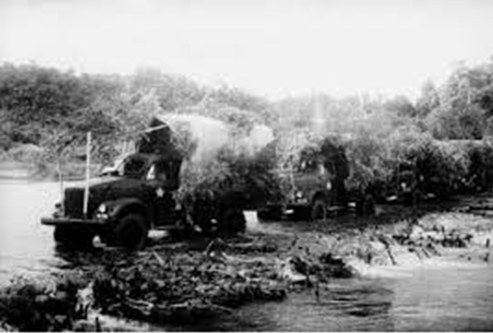
Transporting the aforementioned massive volume of goods over a long journey of hundreds of kilometers required a very strong transport force and highly scientific management. Unlike all previous campaigns in the resistance war, this time the transport means serving the campaign were primarily motorized. A total of 352 transport trucks were used, and at times 94 artillery prime movers had to be mobilized to transport goods. Up to two-thirds of the entire transport truck fleet of the logistics branch were mobilized.
Vận chuyển khối lượng hàng hoá to lớn trên qua một chặng đường dài hàng trăm km cần có lực lượng vận tải rất mạnh và điều hành rất khoa học đảm nhiệm. Khác với mọi chiến dịch khác trong kháng chiến, lần này phương tiện vận tải phục vụ chiến dịch chủ yếu là cơ giới. Tổng số 352 xe ô tô vận tải được sử dụng, có lúc phải huy động thêm 94 xe kéo pháo của pháo binh để vận chuyển hàng hoá. Có tới 2/3 toàn bộ xe vận tải của ngành hậu cần đã được huy động.
Transporter le volume massif de marchandises susmentionné sur un long trajet de centaines de kilomètres nécessitait une force de transport très puissante et une gestion hautement scientifique. Contrairement à toutes les campagnes précédentes de la guerre de résistance, les moyens de transport servant cette campagne furent cette fois principalement motorisés. Un total de 352 camions de transport fut utilisé, et il fallut parfois mobiliser 94 tracteurs d'artillerie pour transporter des marchandises. Jusqu'aux deux tiers de l'ensemble de la flotte de camions de transport du service logistique furent mobilisés.
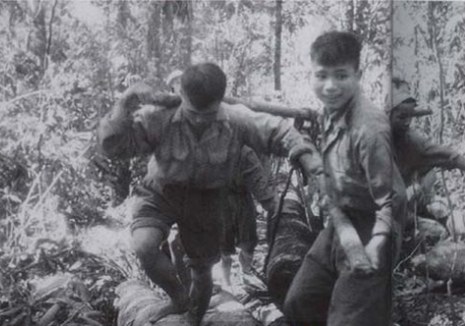
Simultaneously, all rudimentary modes of transport were fully utilized. A total of 2,500 pack bicycles, tens of thousands of bamboo rafts, and tens of thousands of civilian porters carrying loads with shoulder poles and on their backs… participated in transporting goods.
Đồng thời mọi phương thức vận tải thô sơ cũng được tận dụng. Tổng số 2.500 chiếc xe đạp thồ, hàng vạn mảng tre nứa và hàng vạn dân công gồng gánh, mang vác... để tham gia vận chuyển hàng hóa.
Simultanément, tous les modes de transport rudimentaires furent pleinement exploités. Un total de 2 500 vélos de charge, des dizaines de milliers de radeaux en bambou et des dizaines de milliers de porteurs civils (dân công) transportant des charges avec des palanches et sur leur dos… participèrent à l'acheminement des marchandises.
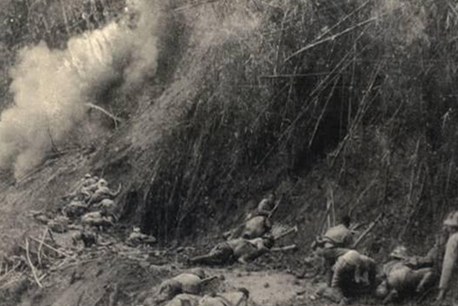
The General Military Commission assessed: "To conduct this very large campaign, we face many difficulties, the greatest difficulty remains supply, primarily the issue of roads"6. First, transportation routes had to be opened for the campaign. Route 13 from Yên Bái to Tạ Khoa was refurbished. The Ministry of Public Works and Transport repaired Route 13 up to Cò Nòi, and Route 41 from Mộc Châu to Sơn La; combat engineers were responsible for the section of Route 41 from Sơn La to Tuần Giáo and on to Điện Biên Phủ. From December 1953, the construction work began. The Tuần Giáo - Điện Biên Phủ road, 82 km long, originally just a 1-meter-wide trail, was widened into a broad motor road. Artillery prime movers towed the guns to within 15 km of Điện Biên, and then the artillery was manually pulled further along a 3-meter-wide path to firing positions 15 km away. This manual dragging route went from the Nà Nham forest edge, over the 1,150-meter-high Pha Sông peak, down to Bản Tấu, across the Điện Biên Phủ - Lai Châu road, to Bản Nghễu. In just over three months (from December 1953 to early March 1954)6, amidst the freezing winter and under bombing and shelling, tens of thousands of soldiers and Youth Volunteers broke mountains and leveled forests, carving out 89 km of new roads, and repairing and upgrading 500 km across high passes and deep streams2. These newly opened roads involved blasting rocks and leveling passes, and were then carefully camouflaged so that French reconnaissance aircraft could not detect them.
Tổng Quân ủy nhận định: “Để tiến hành chiến dịch rất lớn này, ta có nhiều khó khăn, khó khăn lớn nhất vẫn là cung cấp, mà chủ yếu là vấn đề đường sá”6. Đầu tiên phải mở đường vận chuyển cho chiến dịch. Đường 13 từ Yên Bái lên Tạ Khoa được tu bổ. Bộ Giao thông công chính sửa đường 13 lên tới Cò Nòi, và đường 41 từ Mộc Châu lên Sơn La, công binh phụ trách quãng đường 41 từ Sơn La đi Tuần Giáo và đến Điện Biên Phủ. Từ tháng 12 năm 1953, công việc xây dựng bắt đầu. Con đường Tuần Giáo - Điện Biên Phủ, dài 82 km, vốn chỉ là đường mòn rộng 1 m, được mở rộng thành đường ô tô rộng. Xe kéo pháo vào cách Điện Biên 15 km rồi pháo được kéo tiếp bằng tay trên đường rộng 3 m vào trận địa xa 15 km. Từ cửa rừng Nà Nham, qua đỉnh Pha Sông cao 1.150 mét, xuống Bản Tấu, đường Điện Biên Phủ - Lai Châu, tới Bản Nghễu. Chỉ trong chỉ trong hơn ba tháng (từ tháng 12 năm 1953 đến đầu tháng 3 năm 1954)6 giữa mùa đông lạnh giá, dưới bom đạn, hàng vạn bộ đội, thanh niên xung phong đã phá núi, bạt rừng, mở mới 89km đường, sửa chữa nâng cấp 500km xuyên qua đèo cao, suối sâu2. Các con đường mới mở này phải phá đá, bạt đèo rồi được ngụy trang cẩn thận, máy bay trinh sát Pháp không phát hiện nổi.
La Commission militaire générale estima : « Pour mener cette très grande campagne, nous faisons face à de nombreuses difficultés, la plus grande difficulté reste l'approvisionnement, principalement la question des routes »6. Tout d'abord, des voies de transport durent être ouvertes pour la campagne. La route 13 reliant Yên Bái à Tạ Khoa fut remise en état. Le ministère des Travaux publics et des Transports répara la route 13 jusqu'à Cò Nòi, et la route 41 de Mộc Châu à Sơn La ; le génie militaire fut chargé du tronçon de la route 41 allant de Sơn La à Tuần Giáo, puis jusqu'à Điện Biên Phủ. Dès décembre 1953, les travaux de construction commencèrent. La route Tuần Giáo - Điện Biên Phủ, longue de 82 km, qui n'était à l'origine qu'une piste d'un mètre de large, fut élargie pour devenir une vaste route carrossable. Des tracteurs d'artillerie remorquèrent les canons jusqu'à 15 km de Điện Biên, puis l'artillerie fut tirée manuellement le long d'un chemin de 3 mètres de large jusqu'à des positions de tir situées à 15 km. Cet itinéraire de halage manuel partait de la lisière de la forêt de Nà Nham, franchissait le pic de Pha Sông, haut de 1 150 mètres, redescendait à Bản Tấu, traversait la route Điện Biên Phủ - Lai Châu, pour aboutir à Bản Nghễu. En un peu plus de trois mois (de décembre 1953 à début mars 1954)6, au cœur de l'hiver glacial et sous les bombes et les obus, des dizaines de milliers de soldats et de membres des Jeunes Volontaires taillèrent les montagnes et rasèrent les forêts, ouvrant 89 km de routes nouvelles, et réparant et modernisant 500 km à travers de hauts cols et des ruisseaux profonds2. L'ouverture de ces nouvelles routes exigea de dynamiter la roche et de niveler les cols, puis elles furent soigneusement camouflées afin que les avions de reconnaissance français ne puissent les détecter.